Start here: Hardness is measured as calcium carbonate in mg/L (the same as ppm) or grains per gallon (gpg; 1 gpg = 17.1 mg/L). The USGS scale: 0 to 60 mg/L soft, 61 to 120 moderately hard, 121 to 180 hard, over 180 very hard. Your utility's annual report is free; test strips take a minute; a drop-count titration kit gives the exact number you need to size a softener.
Why Test Before You Buy Anything
Hardness varies a lot between cities, and even within one city. Los Angeles, for example, delivers water that ranges from about 103 mg/L to about 235 mg/L depending on the source feeding your neighborhood, according to LADWP's 2025 report. Phoenix reports 172 to 302 ppm. Your number decides almost everything: whether a shower filter is enough, what size softener you need, how much salt you will use, and how hard you should scrub.
Testing also prevents two common mistakes. The first is buying a softener sized from a guess, which wastes salt and water if it is too large or regenerates constantly if it is too small. The second is relying on a product that does not do what you think: most shower filters, for instance, reduce chlorine but do not remove hardness.
Your Testing Options, From Free to Lab-Grade
| Method | Cost | What You Learn | Best For |
|---|---|---|---|
| Utility water quality report | Free | Range for your whole system | A first answer on city water |
| Soap (shake) test | Free | Rough soft-or-hard signal | A quick check with no kit |
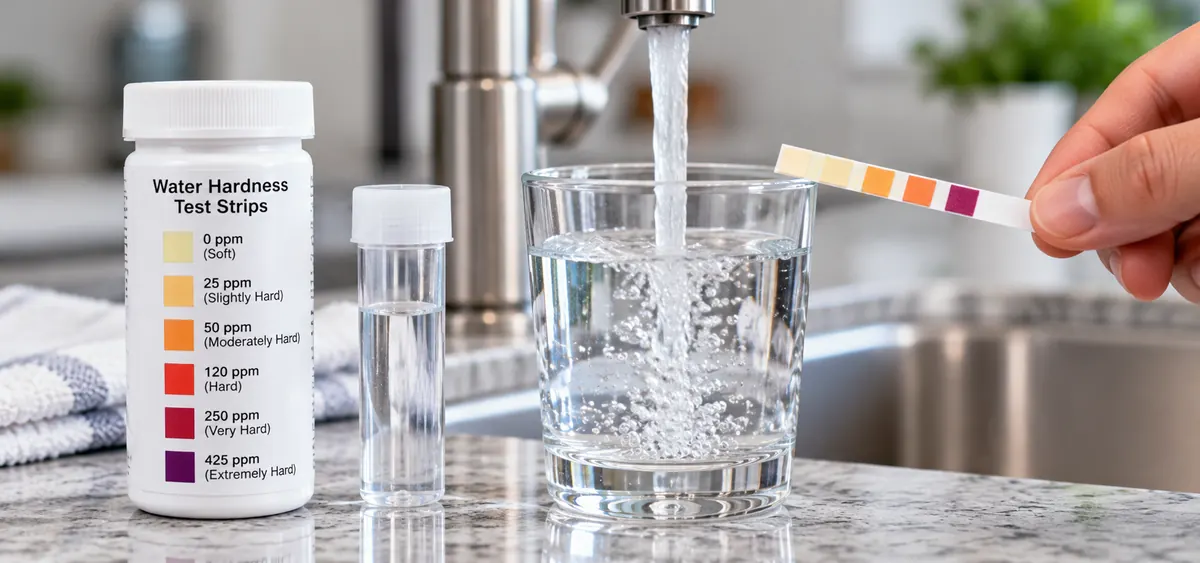
| Test strips | Low | A range, read by color | Confirming hard water, checking a softener |
| Drop-count titration kit | Moderate | An exact number in gpg | Sizing and setting a softener |
| Certified lab | Highest | Hardness plus metals, bacteria and more | Private wells, health concerns |
On city water, start with your utility's Consumer Confidence Report. EPA keeps a finder for these reports. Not every report lists hardness, since it is not a regulated contaminant; if yours does not, call the utility or test at home. Our city guides pull the numbers from official reports for several large cities.
Signs Your Water Is Hard
You often know before you test. The most common signs are white crust on faucets and showerheads, spots on glasses after the dishwasher, soap and shampoo that do not lather well, a film on shower doors, scale in the kettle, and hair that feels coated or dull. None of these prove a number, but if you see several, test to find out how hard. Our hard or soft checklist covers ten signs.
How to Take a Good Sample
- Use cold water. Water that has passed through a water heater may have dropped or picked up scale.
- Run the tap for a minute to clear water that sat in the pipes overnight.
- Pick the right tap. With a softener, test an unsoftened tap (often an outdoor spigot) for your raw hardness and an indoor tap to check the softener.
- Use a clean container rinsed with the water you are testing.
- Follow the kit's timing exactly and read colors in daylight.
- Repeat later. Cities that blend sources can change with the season, so size equipment to your higher result.
The One Tool That Does Not Measure Hardness
Pen-style TDS meters are often sold as water testers, but they estimate total dissolved solids from electrical conductivity. That total includes sodium, chloride and other salts, not just calcium and magnesium. Water can have high TDS and still be soft. A TDS meter also cannot check a salt-based softener, because the softener swaps hardness for sodium and the dissolved solids stay about the same. Use a TDS meter to check a reverse osmosis system instead, and use hardness strips for your softener.
Private Wells Need More Than a Hardness Test
If your water comes from a well, nobody is testing it for you. EPA recommends testing private wells every year for total coliform bacteria, nitrates, total dissolved solids and pH, and testing for other contaminants if you suspect them. It also says to use only laboratories certified for drinking water testing, and notes that local health departments may offer well testing for free (EPA). Well water is also more likely to carry iron and manganese, which affect the kind of softener or filter you need.
What to Do With Your Result
- Soft (0 to 60 mg/L): no hardness treatment needed. If you notice dry skin or hair, chlorine may be the issue; see what shower filters do.
- Moderately hard (61 to 120 mg/L): mostly a cleaning nuisance. Regular descaling and a chelating shampoo may be all you need.
- Hard (121 to 180 mg/L): expect scale on fixtures and in appliances. A softener starts to make clear sense.
- Very hard (over 180 mg/L): scale builds quickly in water heaters and appliances. A water softener is the long-term fix.
USGS notes that hardness is not a health concern, but it can be a nuisance: more soap is needed to get things clean, and heated water leaves calcium carbonate scale that lowers water heater efficiency (USGS).