Best Water Hardness Test Kits (2026): Which Type Do You Need?
Quick answer: For a fast "is my water hard?" check, use test strips such as Varify hardness strips or JNW Direct strips. If you are sizing a water softener, use a drop-count titration kit such as the Hach 5-B, which reads in 1 grain-per-gallon steps from 1 to 30 gpg. For hardness plus metals, bacteria or lead, send a sample to a certified lab. Skip the TDS meter for hardness: it measures all dissolved solids, not calcium and magnesium.
You do not need to guess whether your water is hard. A hardness test takes anywhere from one minute to a week, depending on how exact you need the number to be. The right kit depends on what you will do with the answer: confirm a hunch, pick a softener, or check for things that affect health.
This guide compares the main types of hardness test, recommends a product for each job, and explains the mistakes that give misleading results. Product details come from manufacturer and retailer listings; where a spec could not be confirmed, we say so.
Our Picks at a Glance
| Pick | Type | Best For | What You Get |
|---|---|---|---|
| Varify Hardness Strips | Test strips | Quick check of tap or softened water | Listed as 150 strips, 0 to 425 ppm (0 to 25 gpg) color chart |
| JNW Direct Hardness Strips | Test strips | Alternative strip kit | Listed as 150 strips with an instruction eBook |
| Hach 5-B Titration Kit | Drop-count titration | Sizing a water softener | About 100 tests, 1 to 30 gpg, 1 gpg per drop |
| Varify 17-in-1 Kit | Multi-parameter strips | A broad first screen | 100 strips plus 2 bacteria tests |
| PurTest Iron Hardness Plus | Multi-parameter strips | Iron and hardness screen for softener shoppers | Listed as 8 tests, 2 of each (16 strips) |
| Tap Score lab test | Mail-in lab | Wells, health concerns, exact numbers | Lab report covering dozens of analytes |
Strips vs Titration vs Lab: Which Do You Need?
There are three practical ways to measure hardness at home, and they trade speed for precision.
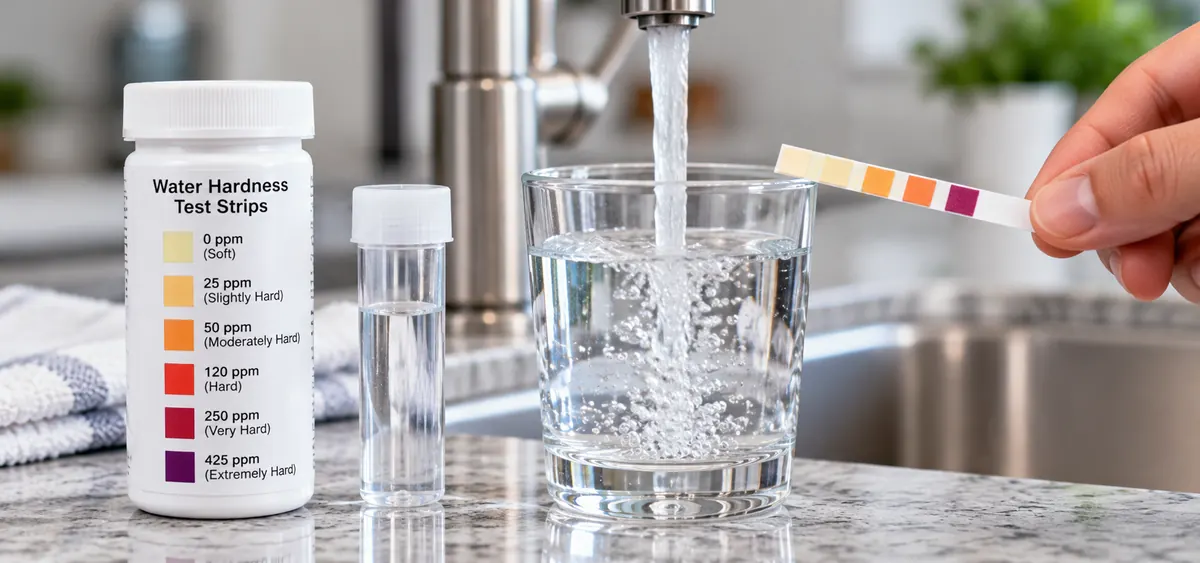
- Test strips change color when dipped in water. They take about a minute and are cheap per test, but you read the color by eye against a chart, so the answer is a range (for example, "somewhere around 120 to 250 ppm") rather than a single number. That is enough to tell soft from hard water, or to check whether a softener is still working.
- Drop-count titration kits use a dye that turns color once you have added enough drops of reagent to tie up all the calcium and magnesium. You count the drops. The result is a specific number, which is what you need to size a softener and set its hardness dial.
- Lab tests measure calcium and magnesium with instruments and usually report many other things at the same time, such as iron, manganese, nitrate, lead and bacteria. They take days and cost more, but they are the only option that also answers "is my water safe?"
If you are on city water, there is also a free fourth option: your utility's annual water quality report. Many reports list hardness, and EPA keeps a finder for these reports. Our city guides pull the numbers out for you where we have them. A home test is still worth doing, because the report gives a range for the whole system and your house may sit at one end of it.
Best Test Strips
Varify Water Hardness Test Strips
The Varify hardness kit is listed with 150 strips and a color chart that runs from 0 to 425 ppm, which is 0 to 25 grains per gallon. That range covers almost every US tap, since the USGS calls anything above 180 mg/L "very hard." Retailer listings mention a waterproof chart, which helps if you test at the kitchen sink.
Good for: confirming hard water, checking softened water at a tap, and quick spot checks over time. Limits: color matching is subjective, and the steps between color blocks get wide at the high end.
JNW Direct Water Hardness Test Strips
JNW Direct strips are a popular alternative, sold as a 150-strip pack with an instruction eBook. We could not confirm the exact ppm scale on the color chart from the manufacturer, so check the chart on the bottle before comparing its readings with another brand's. Like any strip, it is fine for "soft, moderate or hard" and for softener spot checks, not for precise sizing.
Strip tips: keep the bottle tightly closed and dry, since humidity can spoil unused strips; read at the time the instructions give; and compare the color in daylight, because warm indoor bulbs shift how colors look.
Best for Sizing a Softener: Hach 5-B Titration Kit
If you are buying a water softener, the number matters. Softener capacity is calculated from hardness in grains per gallon multiplied by how much water you use, so an error of a few grains changes the size you need and how often it regenerates.
The Hach 5-B total hardness kit (part 145300) uses drop-count titration. Hach describes it as containing the equipment and reagents for about 100 tests reported in grains per gallon. You fill the sample tube, add the buffer and indicator, then add titrant one drop at a time until the color changes. Each drop equals 1 gpg, and the kit covers 1 to 30 gpg. Prices vary a lot by seller, so compare before buying.
Good for: softener sizing, setting the hardness dial on an existing softener, and very hard well water. Limits: it takes a few minutes per test and involves small reagent bottles to keep away from children.
Using a titration kit? Read more about the method in our guide to testing water hardness, and size the unit with our water softener guide.
Best Multi-Parameter Kit: Varify 17-in-1
The Varify 17-in-1 drinking water kit is sold with 100 strips split into sealed pouches plus two bacteria tests. Retailer listings name hardness, pH, chlorine, alkalinity, iron, copper, fluoride and lead among the strip parameters. The bacteria tests need about 48 hours at room temperature.
This kit is useful as a first look at well water or old plumbing: if a strip flags iron or high hardness, you know what to test more carefully. Treat its lead result with caution. A Virginia Tech study by Kriss, Pieper, Parks and Edwards (2021) tested 16 brands of at-home lead kits and found 12 were not suitable for drinking water analysis. The binary strips that did detect dissolved lead missed particulate lead, which is the form that often comes off old pipes and solder. If lead is a concern, use a certified lab.
Best Iron and Hardness Screen: PurTest Iron Hardness Plus
Iron matters when you buy a softener: manufacturers ask you to add about 5 grains per gallon to your hardness setting for every 1 ppm of iron, and higher iron needs its own filter. The PurTest Iron Hardness Plus kit (model 702) is a low-cost way to check both at once. Retailer listings describe 8 tests in one kit: iron, hardness, copper, alkalinity, pH, chlorine, nitrate and nitrite, with 2 strips for each test (16 in all) and a results sheet (Home Depot, Fresh Water Systems). We did not find the strip ranges published by the maker, so check the color chart in the box.
Two strips per test means you can test before and after treatment, or confirm a surprising result once. It is a screening tool: if it shows iron, or nitrate on a well, follow up with a certified lab before buying equipment or making health decisions. For how iron affects treatment choices, see our well water filtration guide.
Best Lab Test: Tap Score
Tap Score (made by SimpleLab) sells mail-in kits: you collect samples at home, ship them to a partner lab, and get an online report. Its city and well packages cover dozens of analytes, and the well packages include hardness minerals, metals and bacteria. Prices change often and vary by package, so check the current listing.
A lab test is the right choice when:
- You are on a private well. EPA recommends testing wells every year for total coliform bacteria, nitrates, total dissolved solids and pH, and says to use only laboratories certified for drinking water testing. Your local health department may offer well testing for free.
- You are worried about lead, arsenic, PFAS or other contaminants that strips cannot measure reliably.
- You are about to spend serious money on treatment and want every number first.
Tap Score is convenient, but it is not the only option. Your state's list of certified drinking water labs, often reachable through the health department, may be cheaper, especially for a simple hardness and bacteria panel.
Why a TDS Meter Is Not a Hardness Test
Pen-style TDS meters, such as the HoneForest TDS meter, are often sold next to hardness kits, and many buyers assume they measure the same thing. They do not. A TDS meter measures electrical conductivity and converts it to an estimate of total dissolved solids. That total includes sodium, chloride, sulfate and bicarbonate as well as calcium and magnesium.
Two consequences matter:
- The same TDS can mean very different hardness. Water high in sodium can have a high TDS but be soft.
- A TDS meter cannot check a softener. An ion exchange softener swaps calcium and magnesium for sodium, so the dissolved solids stay in the water and the TDS reading barely changes. Use hardness strips to check softened water.
Where a TDS meter is useful is checking a reverse osmosis system, which removes most dissolved solids. Comparing tap and RO readings shows whether the membrane is still working.
How to Get an Accurate Reading
- Test cold water. Hot water may have passed through a heater that sheds or collects scale.
- Pick the right tap. If you have a softener, test both an unsoftened outdoor tap (or the softener bypass) and a softened indoor tap. That tells you your raw hardness and whether the softener works.
- Run the water for a minute or so to clear water that has been sitting in the pipes.
- Use a clean container rinsed with the water you are testing, not dish soap residue.
- Follow the timing exactly. Reading a strip too early or too late shifts the color.
- Test more than once. Cities that blend sources can vary by season, so repeat a few weeks apart and size equipment to the higher result.
Reading Your Result: ppm, mg/L and gpg
Kits report hardness in different units. Parts per million (ppm) and milligrams per liter (mg/L) are effectively the same for water. Grains per gallon (gpg) is the softener industry's unit: 1 gpg equals 17.1 mg/L. To convert, divide mg/L by 17.1.
| USGS Classification | mg/L (ppm) | Approx. gpg |
|---|---|---|
| Soft | 0 to 60 | 0 to 3.5 |
| Moderately hard | 61 to 120 | 3.5 to 7 |
| Hard | 121 to 180 | 7 to 10.5 |
| Very hard | Over 180 | Over 10.5 |
Scale: USGS Water Science School. Hardness is not a health hazard; it is mainly about scale, soap and appliances. Not sure what to do with your number? Start with what your result means, or see the water softener section.
Frequently Asked Questions
A drop-count titration kit, such as the Hach 5-B, which reads in 1 grain-per-gallon steps from 1 to 30 gpg. Test strips give a range by color. A certified lab is most accurate of all.
They are accurate enough to tell soft from hard water and to check a softener, but you read the color by eye, so the result is a range. For sizing a softener, use a titration kit or lab test.
No. A TDS meter estimates all dissolved solids, including sodium. It cannot tell you hardness and cannot check a water softener, because softened water has about the same TDS. It is useful for checking reverse osmosis systems.
Test an unsoftened tap (or the bypass) and a softened tap with hardness strips. Softened water should read at or near zero hardness. If both read the same, check the salt and regeneration settings.
Not reliably. A Virginia Tech study found 12 of 16 at-home lead kit brands were not suitable for drinking water, and strips missed particulate lead. Use a certified laboratory for lead.
Test once before buying treatment, then every few months if you have a softener. EPA recommends testing private wells every year for coliform bacteria, nitrates, TDS and pH.
Divide ppm (mg/L) by 17.1. For example, 171 ppm is 10 gpg.
Last updated: October 2026. Sources: USGS, Hach, EPA, Kriss et al., Virginia Tech (2021).